My Travel

Oslo, Day 4. Bygdøy

This was the only foggy morning we experienced in Oslo. Two groups of children got on the same bus as we did, clearly also on their way to the museum island of Bygdøy (a friend told me how to pronounce this correctly, but unfortunately I keep switching to the German way of doing it in my head, which is funny, considering the name contains a letter the German alphabet does not have).

One group consisted of small schoolchildren from Germany, and the other of still smaller Norwegian ones in neon orange vests. The latter simply sat down on the floor of the bus and I amused myself for a while imagining reactions of fellow passengers if this happened in Deutschland. Possibly “Die Kinder dürfen nicht auf dem Boden sitzen.” One little girl boarded the bus in colourful sunglasses and didn’t take them off for most of the trip. Norwegian cool! Apparently it starts from an early age.

The bus number 30 stops in front of every attraction on Bygdøy – another very satisfying transport experience in Oslo for me. My guidebook also told me I could not get lost, as there were signs everywhere, which is true, also no one acts like they can get lost, and as we all know, the right mindset is everything.

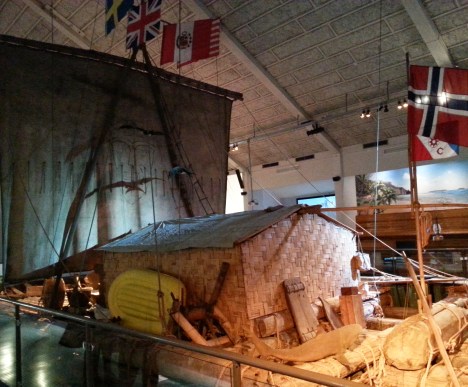
Our first stop was the Kon-Tiki Museum, which I expected to be small and done in a quick tour. Was I ever wrong. A fascinating story opened up to me and I was wondering whether I had really missed this, or simply forgotten. The extraordinary account of Thor Heyerdahl’s trip across the Pacific Ocean on the Kon-Tiki raft in 1947 is constructed in a comprehensive exhibit built around the raft itself. Video and audio plays in the background, additionally animating the story.

The museum also shows artefacts from other daredevil expeditions that Heyerdahl undertook, as well as models of his other (!) rafts. What struck me especially is how much writing he did, not just for scientific purposes, both on his expeditions and between them. After seeing the suggestively realistic underwater exhibit cleverly connected to the raft above, and walking half-bent through a reconstruction of a cave (warning, yes, it is on the narrower side), I immediately bought the book about the Kon-Tiki expedition in the museum shop (generally good stops in the Oslo shopping plan. Psychedelic colouring pencils in the Munch Museum, anyone?).

I couldn’t stop thinking about the fact that several men had actually slept, worked and sailed on this thing in the middle of the PACIFIC OCEAN. On a RAFT. As well as that so many people told Heyerdahl he would never, ever be able to do it…and he did.
IMG_20160317_114331

Inspired and curious after this first fascinating tale, we proceeded to the next museum bearing evidence to more mind-blowingly daring things done by Norwegian explorers – the Fram. By the roof you can tell the building houses a ship. Inside we end up walking downstairs first and watching a bit of the running documentary about the polar expedition made by Roald Amundsen (memories of geography lessons in school start to stir) between 1903 and 1906, aboard the Gjøa. This vessel was the first to sail along the Northwest Passage.

After a few minutes of the film and walking around, observing the numerous instruments, kits, journals, pictures, bottles and clothing, it sinks in just how daunting, not to mention risky, such an undertaking was in those times, when neither science nor technology was as advanced as it is today. These polar expeditions were unimaginably rough, and one can understand the bottles of aquavit displayed around the ship. You would drink too if it happened to you, doo-doo-doo-doo-doo.

IMG_20160317_131030

Fueled by horrified fascination and admiration, we proceeded back to the Fram. First Fritjof Nansen and his crew sailed to the North Pole from 1893 to 1896, achieving fame in Norway and beyond as a result, both for themselves and the Fram. In 1912 Roald Amundsen once again surfaced in connection with a polar expedition, sailing to the Antarctic, to subsequently be the first to reach the South Pole on dog sleds.

The Fram is very big and very impressive, and it’s also possible to go aboard.  Signs with “Please don’t climb on the rigging” are tacked on in several strategic spots. I look down from above. Really? I mean, seriously? Who would even come up with the idea?

Walking on deck I try to imagine the unknown vastness of the North Pole opening up ahead of me, with nothing but ice ahead, and maybe nature making some noise. Inside narrow sets of steps repeat themselves every now and then, as we go from room to room, all of which are quite cosy, though the ceilings are low and I think having only these places to go to for months on end must have been exhausting, though the explorers knew what they might be up against, as best as they could.
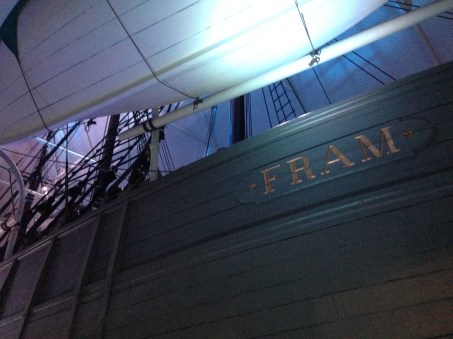
Photo credit @juniperlu

Photo credit @juniperlu

To complete the polar experience, make sure you pop in to this here Arctic simulator. I walked past this door three times before I realized that was the entrance. No more excuses now! And not because of the sub-zero temperatures, been there, done that, hair flip.

IMG_20160317_180423

Next stop – the Viking Ship Museum! For what would a visit to Norway be without connecting with its viking history? The Vikingskiphuset houses artefacts and actual ships found in graves around the Oslofjord. The ships were used by vikings for sea voyages first, and then eventually hauled ashore to become burial vessels. Considering the amount of things (and animals) buried with the dead, one understands the use of the ships, and also with the significance attached to them in the viking way of life, there is something poignant about them being further connected to death and the afterlife, something, perhaps, about viewing sailing as eternal, both literally and spiritually. But these are my own musings only.

The first ship you see, with beautiful carvings on the front, was found at Oseberg, and it was a grave for two powerful women, one of whom had lived past the age of 80 (impressive for times when lifespans were famously short). The other ships and artefacts come from Gokstad, Tune and Borre. All had been ransacked and robbed before being discovered, unfortunately, but they are still currently the best preserved viking ships in the world. Somewhat skeletal, but eerily beautiful, it feels like images of the ships’ former glory are just out of reach. With my imagination buzzing, I made a stop at the museum shop here as well and got a book on viking times. I might have also browsed a little longer by the stall with the viking jewelry replicas. The costume jewelry ones, not the real silver, more expensive ones.

Photo credit @juniperlu

Photo credit @juniperlu

From ships and sailing we proceeded to our last stop – the Norwegian Folk Museum. Upon entering we receive a map with a useful “do not miss” section, which we duly peruse. The Norsk Folkemuseum exhibition is located completely outdoors (with free WiFi available) and it is very easy to feel as if you have indeed gone back in time, alternating between periods. Showing life in Norway from as far back as 1500, the museum does this through 160 historic buildings relocated from various sites. We barely saw anyone while there, which contributed to the pleasantly tingly ghosttown feeling (but since by this point it was sunny again, my imagination quieted somewhat after the viking ships).

A particularly interesting stop is the Wessels Gate 15 apartment building, which you can enter and see 8 apartments with interiors from the past 130 years. This was very cool, especially since it looked like the owners would pop back in any minute. The sun was still shining and a Beatles song was playing in the 60s section. One kitchen we could go in, but I couldn’t open any cupboards or drawers (probably nailed shut precisely because of visitors like me). The rest was observed from behind glass walls.

This slideshow requires JavaScript.

So much history in one day, and absolutely worth the time. I can’t even begin to decide which attraction I enjoyed most – they were all part of an incredibly exciting discovery of Oslo’s museum landscape. All of the above are included in the Oslo Pass.

We caught the bus and settled back to digest the day’s impressions during the next 20 minutes until getting out in town. Then we realized we still had time for another planned activity…

Standard
My Travel

Oslo, Day 3. Harbour and Vigelandsparken

No, day 3 is still not over! “And I just can’t get enough/ And I just can’t get enough.”

We took the tram (Oslo is the only city in Norway with trams, or trikken, by the way, and I think the last time I rode one was in Prague) to Aker Brygge, one of the most convenient points to get out at if you want to explore the square around the City Hall, as well as walk along the harbour by the Oslofjord. We walked along the right-hand side, if you face the fjord, with the still cloudless deep blue sky reflected in the water and the afternoon sun contributing to the impression that everyone around us was also on vacation, despite the fact that it was Wednesday. Fancier-looking restaurants filled with guests lined the promenade, along with ice-cream kiosks, and more attention-grabbing modern Oslo architecture popped up, in brick, glass and steel. We fantasized about what it must be like to live in an apartment with such a view and were enchanted with the observation point at the end of the walk, opening up to yet another breath-taking vista of the Oslofjord. Why is everything so beautiful?!

IMG_20160317_072113

IMG_20160317_071814

IMG_20160317_072337

To the left of the observation point (which turns out to be right by the Astrup Fearnley Museum of modern art, the cool building with the slanting roof) is a bathing area. Some are sitting on the sand, relaxing in the sun, but one guy in bright blue swimming shorts (yes, I have an eye for details) catches my attention. He’s quite tanned for this time of year and he’s the only one on the higher bit of wall clad so modestly. No one seems to mind or really notice, though. And like it’s the most natural thing in the world, he leaps in to the water, while his dog tensely watches. Just a refreshing dive. I pull my hat down more snugly over my ears and wonder about coming over here again in the summer.

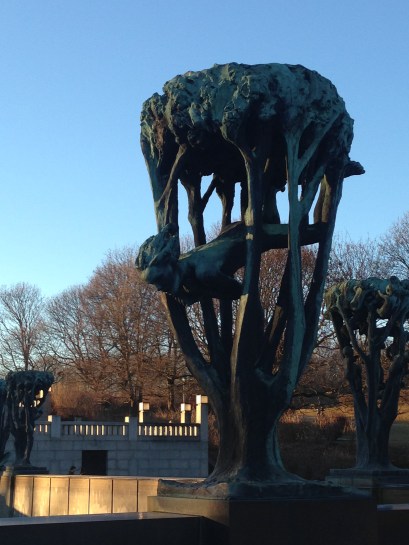
After that we were ready for the next item on our Oslo list – Vigelandsparken. On to the tram again and past some very pretty houses. The park consists of five parts, all together combining 212 sculptures by Gustav Vigeland. Materials include bronze, granite and wrought iron. That intoxicating feeling of space and calm enveloped us once again as we entered through the main gate, also a work of art on its own, and proceeded along the bridge stretching ahead of us. The bridge was lined on both sides by numerous sculptures, and after viewing quite a few more than expressive works concentrating on the nude human body in the Munchmuseet earlier, I was unusually conscious of the fact that all these figures were also naked. The figures depicted men, women and children caught in active movement, interacting with each other, and we quickly discovered the best game in the place – imitate the poses and take pictures. Keep a lookout for the Angry Baby (how most of the visitors refer to it) on the left, or auf Deutsch The Angry Little Boy. Due to excessive instagramming on the go, my phone also decided to chill when we got to the park, but my friend very kindly lent me her’s after seeing me fidget. Vigeland’s sculptures are a source of endless thoughtful discussions. “What did he mean by this one? This is quite interesting… Wait, is he throwing the baby?”

Photo credit @juniperlu

Photo credit @juniperlu

A large fountain with more fascinating sculptures follows the bridge, and even if it’s obviously not turned on yet, it’s fun to walk on the edges and scrutinize the more mythical depictions in front of us. I’m enjoying the people theme, it makes me think and feel very absorbent of Oslo’s local flair.

IMG_6242

Some steps need to be mounted after the fountain, and we find ourselves on one of the most famous parts of Vigelandsparken, the monolith. 121 figures carved from stone silently tower above the park. They took 14 years to finish. Visitors sit on the steps surrounding the monolith, and once again some of the sculptures provoke a reaction best described as “Um…” Bottom line, though: the whole structure is mesmerizing.

Photo credit @juniperlu

Photo credit @juniperlu

IMG_6257

Photo credit @juniperlu

Photo credit @juniperlu

All this monolithic viewing required a meal of respectable proportions as well, so we settled down in Kaffistova to some traditional Norwegian food and a discount with the Oslo Pass. What a day.

IMG_20160318_001211


Standard
My Travel

Oslo, Day 3. Operahuset

Do you know how sometimes you get very excited about seeing a particular landmark when you travel, you read up on it, you hear about it from other people and keep going over the same parts in your city guide (yes, I like to have a book with me), but then you arrive there and your excitement is not only confirmed, but immediately transcended? That was what it was like for me with the Oslo Opera.

There are so many things known about Norway’s largest music and performing arts institution to make it intensely interesting. We walked from the Munchmuseet – it takes about 20 minutes (17 at a brisk pace and without stopping to briefly get your bearings with the aid of Google Maps – darn, it’s cool to watch that arrow move along with you). The sunshine was as brilliant as ever, and en route we walked right in to the Barcode District in Bjørvika, Oslo’s new financial and business area.

A tall bridge spanned across the distance, with a massive construction site and train tracks underneath, as literally bars of buildings rose from the ground, glas windows reflecting the blue sky twinkling among differently coloured concrete. These current urban planning projects may be getting their share of controversy, but I found the architectural view mesmerizing.

IMG_20160317_000034

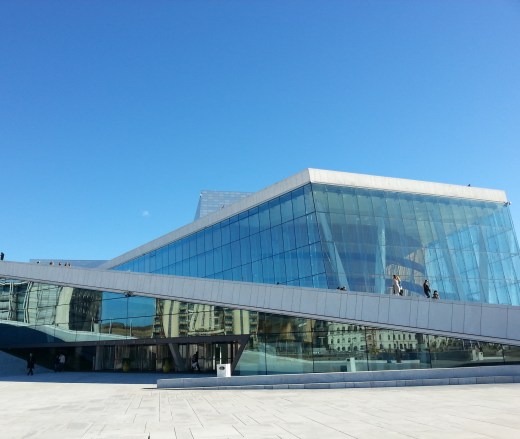
We hurried on, getting increasingly excited as the Opera came in to view. A quick dash along the side, as beyond us lay another enormous building site, and a quiet hope that we would indeed arrive at the main entrance. We did, and as I turned the corner, everything I had read or thought about the Operahuset was briefly wiped from my mind when I saw this.

IMG_20160318_104520It was a very clear, sunny day, made for showing off the Opera to its full advantage. But even so, nothing can take away the impression that this is both a building and a ship, seamlessly transitioning from one to the other as the marble roof diagonally meets the water on one side. White, blue, grey, marble, glass, stone – a bedazzling mix.

We arrived with 5 minutes to spare and I asked at the ticket office where to go, my German sensibilities forcibly colouring my aura. The clink of utensils on plates mingled with relaxed chatting in the café nearby and light flooded the spacious entrance hall.

Our charming and knowledgable guide won me over with his repeated “Come,” as we delved further and further backstage. Now, I have a romanticized view of operas and their world since I a) saw Phantom of the Opera with Emmy Rossum; b) ended up remembering the soundtrack by heart; c) interned at the press department of the Hamburg Ballet and was fortunate enough to go backstage at the local opera theater.

We went up to the higher rows of the largest stage, and we were very high up indeed. Darker wood dominated the space big enough for more than 1,300 people. Rows were mostly built in circular lines, making you think yet again of water and waves. Various detailed acoustic considertations were taken in to account when building, hence the different patterns on the velvet covering of each seat. Each seat back also has a small screen on it, where translations are displayed in 8 languages! Most progressive opera house in the world, or what?

I want to go see a performance there so badly now.

Masses and masses of complicated looking equipment loomed around us backstage. We heard singing, saw ballet dancers pass as we walked through the dance rehearsal area, and I happily recognized a Norwegian poster for Swan Lake. Most places where people worked and rehearsed seemed to have a lovely view, though all female members of the ensemble get dressing rooms looking out on the water. “Have to be nice to the ladies”, our guide said. Some 4,000 costumes are made for productions and the sewing area looked large, intimidating and incredibly efficient.

After the 50-minute tour ended, I had many questions, of which I got to ask two, but ours was not the only tour scheduled. Later I once again joyfully buried my nose in my guidebook again.

What is repeated about the Oslo Opera – it was built to touch, to feel, to experience – is true. That accessibility and space is immediate. Your experience of it doesn’t start with a purchased ticket for a performance – it starts before that. You can walk on the Opera, around it, sit in the sun, picnic on the roof and marvel at the incredible way modern Oslo architecture blends in with the local landscape.

Do You Remember, one of my favourite songs by Norwegian singer-songwriter Ane Brun, performed on the roof of the Oslo Operahuset in 2012.

Standard
My Travel

Oslo, Day 3. Munchmuseet

Post-Ylvis and after staying up until 2 AM, we were ready for some more culture and observations. A quick look at the map proved that fitting two activities in the first half of the day would (probably) work out, so off we went to the Munchmuseet (free with the Oslo Pass). Sunny weather continued to accompany us as we followed signs that conveniently popped up every few meters (I LOVE that, it’s like someone is reading my mind and encouraging me at all the right moments. Thou shalt NOT get lost!).

The fact is, everyone knows Edvard Munch’s work, even if they don’t know him. Certain images have made their way around the world and it’s another educational stop on the way to discovering Oslo, as well as Norway’s modern art history. Part of the museum is under reconstruction and closed. The building is white, rectangular, streamlined and filled with light inside, like many others in Oslo. The security check before entering the exhibition surprises me at first, before I remember that the Munchmuseet’s version of Scream (1910) was stolen in 2004 and later recovered.

IMG_20160316_122340

Scream was not displayed this time, but I immediately recognized Madonna, looked for a while longer at The Kiss, shivered by Murderess and found Despair unexpectedly arresting. The way the figure in the painting stood was recognizable and provoked sympathy, in addition to the special satisfaction I get from just a on point depiction of human feelings. The exhibition combined both the works of Edvard Munch and Robert Mapplethorpe. The (nude) human body was a focal point of the work presented, which is fine, as it has been thus for centuries in art. However, I was still grateful for spotting a sign with “Warning: sexually explicit content” on it, and rounded the corner with caution. With good reason!

A stop at the museum café is a satisfying conclusion to the Munch experience. True, one cake slice cost double what I would pay in Hamburg, but it was delicious and hey, an absolute scream.

IMG_20160316_120502

Standard
My Travel

Oslo, Day 2. Ylvis

What would a visit to Oslo be without Norwegian comedy brother-duo Ylvis?

IMG_20160316_221146

Magnus, Vegard, Bård and Calle greeted us on a daily basis from posters as we passed the Folketeateret on our wanderings. The actual entrance to the theater is inside a lovely, spacious passage housing several restaurants, and the smell of delicious food would be one of the first things we’d register when we would pass through. It all became very familiar and people-watching by this pretty fountain, or just relaxing briefly with a snack wasn’t frowned upon.

IMG_20160314_230558

We had tickets to a live taping of the talkshow I kveld med YLVIS (Tonight with Ylvis), and the evening was particularly exciting as this was the last episode. We had a bite in the Burger Bar, with sweet potato fries and a delicious blue cheese dip for me – good preparation for the laughter and subsequent activities that followed the show. In an hour the faces of diners around us became familiar as well and I recognized many not only later in the theater, but even the next morning in the hotel. Many of them were (covertly) looking around, like us, possibly hoping to catch a glimpse of the Ylvis brothers, who are known popping up in various places around Oslo, the theater passage included.

Once the theater doors opened we poured in with the rest of the excited crowd – the building was beautiful inside. A long, layered glittering chandelier descended from the ceiling above a wide staircase, and the above hall with the bar was a harmonious mix of dark wood, plush seats and dim lighting. Once again that feeling of space – how do they do that everywhere? Every staff member, bartenders included, were wearing I kveld med YLVIS t-shirts. We settled by the bar with our drinks, chattering, when the bartender approached me and spoke in Norwegian. “I’m sorry?” I said politely. “I need to take your water glass, because they are going to use it in the studio,” she said, then, seeing the mingled surprise and excitement on my face, added the somewhat cryptic bit, “I’m not going to wash it.” I handed over my (still full) glass, she gave me a plastic one same as the rest of the population, and gave the original to a young guy also wearing an I kveld med YLVIS shirt.

We debated whether traces of my lipgloss would be visible on the glass, thus providing an exciting possible connection with the evening’s celebrities, but from where we were sitting it was impossible to tell. I do hope the glass did get washed, though.

A live band played on two balconies across from each other, and the guy signalling to us how to clap was doing a very good job, but the audience really didn’t need much encouragement. Finally, the lights dimmed, and the Ylvis brothers ran out on to the stage. After lots of YouTube videos, it was fantastic to see them in the flesh.

Before they even began interacting properly with the audience, which is a standard starting point of the show, a woman sitting a few rows away from the stage jumped up and began shouting something shrilly. She was quite short and I couldn’t make out what she was saying. However, Vegard and Bård leaned forward slightly, with concentrating looks on their faces, and after several attempts to understand her, it became clear what she was so desperate to get across: “I’M FROM THE UNITED STATES!” “Mah Gawd!” Bård responded immediately, getting the audience to clap with him. Another guy piped up with the same information and promptly got chastised by Bård: “You missed by 20 minutes!” After some more questions and politely acceping gifts being handed on the stage, Bård firmly declared this part of the show was over and it was all Norwegian now. Kudos, a brilliant and sharp bit of improv.

Despite not speaking Norwegian, the show was fast, snappy, fun and easy to follow, especially since Magnus, Vegard, Bård and Calle were all familiar to me, and my friend was a walking Ylvis encyclopedia. Any question you asked her about Ylvis, she had the answer. And thanks to loyal Ylvis fans, videos of the show and other stuff they do in Norwegian get translated in to English quickly. It was particularly interesting to see how a talk show was filmed, even more so when we watched the whole thing again on TV the following night, and spotted ourselves in the audience.

The show concluded with Calle, Vegard and Bård doing equally fantastic imitations of the lead singer of Norwegian dansband Ole Ivars, who was present to judge. They really couldn’t have gone out better (and the bus with Ole Ivars emblazoned on it finally became clear to me, as well as Bård’s cryptic Instagram post from earlier, but not being local, I’m allowed).

But the night wasn’t over yet. After some hanging around in the passage outside, watching the numbers of those waiting dwindle, the mother of one of the girls ran outside to check some apparent commotion. The daughter held her phone at the ready and I could feel all eyes focusing on her like a traffic light. Suddenly she got up, as did several others, and then we were all hurrying outside to square at the other end…where Magnus and Calle were taking pictures with excited fans (standing in line). “Thank you for coming,” Calle said in response to my thanks for a wonderful evening, as did Magnus, and they both took time to chat with us, despite the late hour, and it was all simply lovely.

After more waiting (those burgers were good!) we heard several girls gasp, “Bård!” and he appeared, but after one female fan shoved her selfie stick at his face with the force of Arnold Schwarzenegger on a good day, he gave a slight shake of the head and made a “Nuh-uh, dude” face, disappearing in to the bar next door. Laughing, we left, having definitely put “the right amount of pressure” on this very cool evening.


Standard