Hamburg

Random Struggles in German

Even after many years of living here, I have a list of words and phrases I still need to look up. That’s actually fine by me. First of all, I’m not a computer. Second, learning a language never really stops, because it’s a process and languages are living things. Wouldn’t it be boring if you just knew all there was to know? Third, it creates interesting conversations. Fourth, it gets me my regular dose of laughing. So off we go…

Fordern and fördern – one means “to demand” and the other means “to support” or “to sponsor”. I routinely forget which is which and sometimes end up using the wrong one in a sentence. Neat trick: at the same time it’s easy for me to remember that Förderung means “sponsorship” etc., so I can make the appropriate conclusion if I catch myself in time. Otherwise I just opt for a synonym or still do that thing where my voice kind of sinks, I don’t finish my sentence and expectantly look at my (usually) native German-speaking conversation partner.

Schnurren and schnüren – well, the first only has one meaning, “to purr”, and the other one means “to tie”. Sometimes I’ll use the first one, but pronounce it like the second, and then I’ll forget the ü when I’m talking about shoelaces (a subject that pops up more often than you’d expect), which, incidentally, in German are called Schnürsenkel. They might also lose an ü when I’m trying to kindly tell someone their laces got untied, and I spend 5 seconds remembering whether the plural gets an n at the end or not. The answer is no. By the way, a friend of mine once offered a lovely solution, and since she’s German, I tucked away the phrase she used with total confidence. “Oh,” she said, pointing at my undone shoelace, “deine Schleife ist auf.” This translates as “Your ribbon came undone.” Wonderful.

Tablett and Tablette – the first one means “tray” and the second one means “pill”. The second one was easy to remember, because the Russian word is very similar, not to mention the English one. But these are also the reasons the first one confused me at first. At the same time, the article of Tablett stuck in my memory from the first time I heard the word. Go figure.

Schnacken – this is northern German, which means I was hearing it very soon after arriving in Hamburg. Another example of how far the textbooks in class can take you before you have to dive in for real, whereupon the lessons start all over again. Was this the German pronunciation and adaptation of “snacking”? Nope, it means “to chat”, but it’s also used in a work context between colleagues who either know each other or assignments they are expected to work on together well.

Two examples which showcase my inventions basically influenced by translating English from my head into my German speech.

Relativ neulich was “pretty recently”, but it’s not used. Just neulich or vor Kurzem. Noted. I’d gotten away with it for a couple of years, though. So either no one noticed, or they were all patient and polite, not wanting to offend me, waiting it out, taking their time, analyzing what I’d said and making lists…

Ein ernstes Stück Fleisch – this innocent literal translation of “A serious piece of meat” while describing a fantastic hamburger (yeeeesss) dinner caused a lot of mirth and became a, dare I say, beloved quote. Ein ernstes Stück Kuchen (cake), ein ernstes Stück Käse (cheese). You name it, it works.


Standard
Hamburg

Blankenese: A Lovely Retreat in Hamburg

Blankenese is a gorgeous district in Hamburg directly overlooking the Elbe river. I thought I “did” the Elbe for now after I walked around the Speicherstadt and Övelgönne, but you can’t ever really be done with one of the longest rivers in Europe, especially if you live in Hamburg, can you?

Blankenese is often described with the following adjectives, which I have been hearing since my student years: posh, chic, expensive, fancy, rich, affluent – you name it. I also used to think Blankenese was Övelgönne, shhhh. I’m not confused anymore. You can actually walk or cycle to Blankenese from where I stoppped during my walk in Övelgönne, just be prepared to cover quite a distance, though that’s also the cool thing about the Elbe beach that follows that whole walk – you can just keep going and going and going.

It’s easy to get to, taking the S-Bahn train being one example and then just getting out at Blankenese station. The trip wasn’t as long as I expected, in fact, I barely read two pages of the book I brought with me. The sun is shining (which always tends to get noticed with extra jubilation around here) and when I get out I’m reminded of my first impression from years ago – arriving here feels like you’re on vacation at some resort spot, provided it’s not winter. You can walk a little bit along what is essentially the high street here, stop by the weekly market, stop to get some lunch (from the supermarket salad bar for me, and then eat on a bench by the water later).

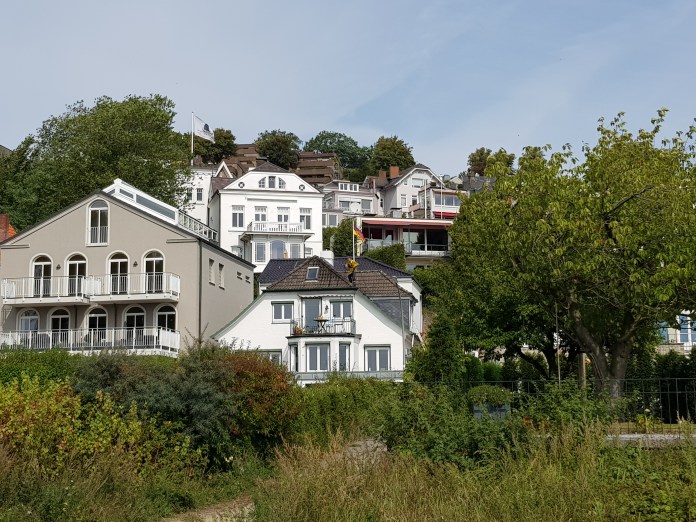
My actual goal is the so-called Treppenviertel, or staircase quarter, which is conveniently pointed out by signs and doesn’t take long to get to. Hamburg is widely referred to as a flat city and that fact is true, except for Blankenese where it gets quite hilly by local standards. On my left gradually descending rows of pretty villas and shrubbery are interspersed with stairs that all lead down to the sparkling silver of the Elbe. I pick the nicely level Strandtreppe (beach stairs).

Taking any close-ups of all the pretty facades around is actually tricky. You might glimpse a nice view from higher up or further away, but when you get nearer, you discover that what you wanted to photograph is actually skillfully hidden by bushes, walls or fences. Which I respect. Blankenese used to be a fishing village and then changed to a popular getaway later in the 19th century, attracting wealthy families who in time decided to live there. Many of these families had ties to Hamburg’s maritime history and trading industry.

Once you arrive downstairs, it’s off to the right, along the water, with typically northern German landscape understatement all around: modest at first, beautiful and memorable upon a closer look. I’d looked up lighthouses in the Hamburg region before this walk, and this is one of them. It’s going to be demolished next year as soon as new ones are built.

Meanwhile, you can’t go all the way up to the top, but there’s an observation deck which is still high enough for this classic view of the Blankenese shoreline.

Standard
Hamburg

You Can Tell It’s Spring in Hamburg When…

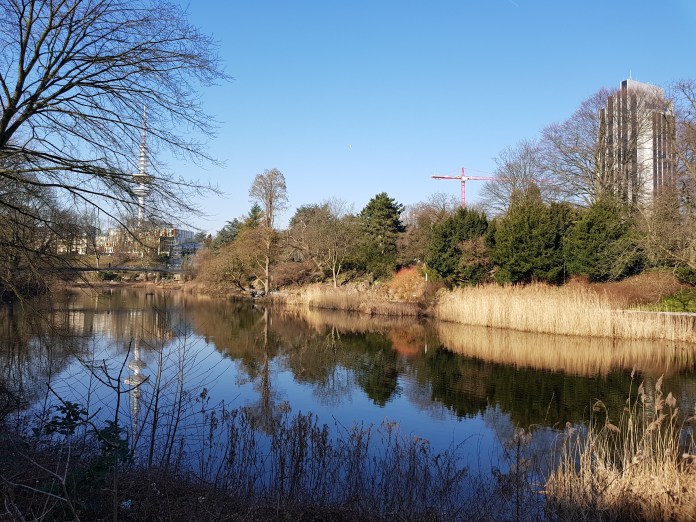
Your favourite park doesn’t look like it’s sleeping anymore even if the trees are still bare, but they are not actually bare anymore, they are clearly waiting.

People are walking around with those tell-tale, increasingly ubiquitous regardless of the season stretches of bare ankle between low sneakers/ Chucks/ loafers and cropped jeans or chinos.

Jackets and coats are FLUNG open. Scarves flap in the light breeze or are discarded completely. Those daring enough sit without coats on in patches of direct sunlight. Sunglasses are worn like we do it every day.

Cafes start setting up tables outside, though with blankets discreetly draped over chairs.

There are crowds of people walking anywhere by the water, which definitely means the Außenalster (bigger Alster lake), the Elbe and the Port of Hamburg. No one will be going away for the weekend.

The sky was so blue and virtually cloudless (we always notice that here) during the day that in the evening, once it starts getting dark, the blue just deepens and you can see the almost full moon as clearly as if you painted it up there yourself.

Oh, and there was that little fact of it being 14 WHOLE DEGREES today. Let it be noted down in history that the first day of spring in Hamburg in 2019 was February 16 and it has so far lasted beyond the weekend. We’ll see what happens.

Standard
Hamburg

10 Years in Hamburg: 10 Things I Learned Here

10 years in Hamburg! 10 years of living in Germany’s jewel of the North, eating Franzbrötchen (local pastry), buying a new umbrella at least twice a year (it rains regularly), saying Moin (local greeting), walking around the Alster lake and river, loving Hamburg Airport for not yet being big enough to need a shuttle train or bus, getting tipsy from sunshine when it makes an appearance, not being able to drink sparkling water (it hurts and only makes me thirstier). Oh, Hamburg.

A friend recently asked me if these 10 years felt like a long time to me. The honest answer is yes and no, or jein in German – a combination of ja (yes) and nein (no). I remember my first few months here very clearly, as well as the years that followed, but I also feel the weight of all that I’ve experienced and achieved, in a very reassuring sort of way. I guess the conclusion is that I respect what was, appreciate what is and look forward to what will be.

It’s funny to look back and see that the two times I pondered whether I made the right decision in coming here, several years apart, were both caused by experiences which I’m sure would not have led me to such dramatic thoughts today. On the other hand, during a difficult phase when my future truly was suspended in midair, I never once doubted that I wanted to be here.

So just what have I learned while living here? Well, to narrow it down to 10 points…

  1. Say Moin! It’s short, it’s got just one syllable (I’m a big fan of short greetings, so effortless, so elegant, so quick, so easy in this busy city life on the go) and it’s undeniably local. You can say it almost anywhere – in shops, when you enter a bakery, in a club, and it might even soften up the grumpy clerk you need to approach for paperwork and whom the whole student dorm recognizes the moment you describe him. I didn’t say it as often during my first year here, but it would pop out all the time as soon as I traveled somewhere else. Not necessarily a good idea in Bavaria… But in Hamburg, and mostly anywhere else in the North, Moin!
  2. Unless you really want to, you don’t necessarily need to buy a ticket for the harbour boat trip tour. Your local HVV ticket (full-day one is the best option) is valid for ALL types of transport in Hamburg, including the ferry! There are ticket machines right on the ferry as well. So hop on at Landungsbrücken station and cruise back and forth along the Elbe as long as you please. Go to the top deck if the weather is dry. This is also a great way to unwind after work and enjoy an unexpected Indian summer.
  3. Franzbrötchen, a type of local sweet pastry with sugar and cinnamon, are constantly discussed, ranked, tested and covered by a variety of good local websites. Buy one, try one, or buy several and try them all, pick one or don’t, get in to conversations about them. Try the ones with extras like chocolate or crumble if you’re feeling adventurous, though I think in the end the original always wins.
  4. Labskaus is a traditional Northern German dish, and for years I’d find myself talking about it to people without trying it. I’d seen pictures, of course, and the moment I did eat it, I discovered it was delicious, somewhat in discord with what you think when you see it first. Have no fear.
  5. You will always find an umbrella in Rossmann or Budnikowski, those two drugstore chains sprinkled throughout the city. And trust me, you will keep needing one. Unless you prefer raincoats. Either one is indispensable around here. Occasionally getting drenched creates a sense of community and team spirit.
  6. I have always loved being near the water and Hamburg firmly cemented this fact in my adult life. The Elbe and the Alster cover any mood you might be in. I have lost count of how many times I’ve walked around the Alster in particular.
  7. No, people are NOT cold here. They just take their time sizing you up, and don’t forget you can do the same. Personally I like this, and it might be influenced by the fact that I’m an introvert, though a very communicative one. After some careful observing and that first coffee or drink you might find that you’ve met a wonderful friend who is still there ten years later. Patience!
  8. If you find yourself talking to a fan of one of Hamburg’s two football teams (St. Pauli or HSV), and you don’t follow either, plus you don’t know your conversation partner too well, perhaps it’s a better idea to listen to the person for a while first. Or indeed just listen, instead of blurting out, “Wait, don’t they keep losing?”
  9. There is a very high chance that your favourite band or singer will make a tour stop in Hamburg.
  10. It’s enough to be able to sing just a bit of Hamburg, meine Perle by Lotto King Karl to feel like you belong here. Everyone around you will join in and sing the rest anyway.
Standard
My Travel

Discover Northern Germany: Husum

Husum is a beautiful historic town in the German state of Schleswig-Holstein worth checking out if you want to discover Northern Germany. Lovely walks along streets lined with old brick houses typical of the area and everything being reachable on foot make for easy planning while you’re there.

This slideshow requires JavaScript.

Cold winds blow in January from the North Sea nearby, brilliant sunshine might be expected and there are lots of places to stop by for a cup of tea – popular beverage here. The traditional Brauhaus Husum in the Neustadt street is a recommended stop if you’re interested in the local beer culture, and there’s even a proudly sold local brand of mineral water, Unser Gutes Husumer.

The local castle is a good place to start if you want to get a town history fix and the park around it fills with crocuses in the springtime. Even now in this cold winter weather tiny ones are sprouting up from the earth. The Schlosscafe, located right in the castle courtyard, serves tasty (and cheap) dishes, as well as delicious, generously sliced cake. It’s a good way to finish the visit to the castle (which follows a route noble guests were expected to take in the olden days – you might get a guide from the stern lady at the entrance and don’t even think of saying no). I didn’t know Czar Peter the Great visited Husum during the Great Northern War (dim memories of history lessons in school), or that the town used to belong to Denmark. Many signs in the castle and other places are written both in German and Danish.

Husum is also the birthplace of Theodor Storm, an important influencer of the country’s 19th century literary scene and connected to the development of realism in German literature. After walking through all the rooms of his house, which has stayed largely unchanged since his death, through two world wars and despite other owners, it’s amusing to find out that Storm collected and penned ghost stories (Spukgeschichten), which had been unpublished for a long time before being discovered. The receptionist tells me about children huddling around a fireplace in kitchens during dark evenings, while that cold wind raged outside in streets that weren’t yet lit the same as nowadays. They would tell each other these stories, both drawing from what they had heard elsewhere and making things up as they went along. This certainly creates quite an image in my head!

Just like in Hamburg, people say Moin in Husum. Another gem in Northern Germany.

Standard