Thoughts

Confessions of a Clueless Football Viewer, Part 2

This football, I like it, another! To rephrase Thor a little bit.

England and Russia played against each other on Saturday and having Russian roots I thought, hey, why not. No clue about the Russian national football team, no prior research, not even a glimmer of a name, and my knowledge level about England’s team wasn’t much better – the only player I recognized was Wayne Rooney, and all I could come up with additionally was the oft-repeated comparison on his facial similarity with a certain beloved animated character. Oh, well, I never said I could do much.

Thus with basically an absense of feelings except curiousity on how this whole game would go I sat down to watch the match taking place in Marseille. I did predict the colours of the Russian team’s uniform’s correctly. Yay. Of course they were going to be red, vot do you mean.

I was just thinking this match was somewhat boring beyond the fact that my cluelessness already glaringly signifies the possibility of boredom, when suddenly England’s Eric Dier scored the first goal. Yes, goals are always sudden, that’s the thing that sets them apart, I know. The goal was half the fun, though, ultimately leading to the best part of the whole game as a screaming bunch of running players went nuts and failed to brake around this poor photographer.

He took it well, though. But Russia was not to be completely outdone, making jaws drop all over the stadium as they scored a (sudden) goal of their own during the three minutes after play. The look on Vasili Berezutski’s face as he demonstrated the usual victorious displays of emotion following his hit can only be described as “I AM BEAR.”

Despite the 1:1 tie, an amusing little summary of what is possibly one of the baselines of each national mentality emerges: England was “dejected”, according to multiple headlines in the media, while Russia acted like a winner.

It was impossible to ignore the staggering amount of violence taking place in the streets of Marseille as English and Russian football hooligans attacked each other in a seemingly endless frenzy of determined aggression. With widespread ugly incidents also taking place right in the stands of the stadium after the match ended, media, fans and locals alike are appalled. The acceleration level is dizzying and it is once again horrifying to see a sports environment or occasion abused purely for the purpose of destruction.

With the security concerns this year’s Euro brings, it is especially sad, and absolutely disgusting, to see this senseless violence happening, and one is particularly sorry for real fans who would never commit such a crime, not to mention the already overstretched law enforcement involved with keeping match locations safe and locals who must feel as if they are suddenly under siege in their own city.


Standard
Thoughts

Confessions of a Clueless Football Viewer, Part 1

The UEFA Euro 2016 has begun and after (somewhat unexpectedly) viewing a few of these in recent years, I can once again predict some of the things that are going to happen in the coming four weeks.

I will watch a few games and surprise myself anew that I actually do this, because if ever there was a person well versed in one-dimensional, non-technical sports viewing, it’s me. Fan accessories in the colours of the German flag, from wigs to flags to sunglasses to face paint, will spill from most of the supermarkets and drugstores one passes in town, and I will remember the paint stick a colleague made me throw away after a news report about a bad batch being produced.

Most of us will watch the matches with Germany, though we might forego Hamburg’s largest public viewing spot at the Heiligengeistfeld with its 50,000 football fans.

I will not be able to comment on any technical parts of the matches and keep silent as the tangle of both English and German football terms (Abseits! Torschuss!) becomes ever more confusing in my head.

It’s all good.

I found myself watching the opening match between France and Romania of my own accord, partly also because of the game taking place in the Saint-Denis district of Paris, with sad memories of the November 2015 terrorist attacks and subsequent raids in the area being expanded by current security concerns. There is no light-hearted viewing this year, as clueless as I may be sports-wise. But there is an ongoing wish to enjoy what this championship is supposed to be about – seeing the best at their game, international sportsmanship and excitement about a big event being followed all over Europe.

France won against Romania 2:1, with the host country’s team possibly being surprised by the agility of their opponent. With my notorious ability to get teams mixed up I was thankful the French players were wearing blue and the Romanian ones yellow. I always think while I watch and as my attention inevitably starts to wander that so many people are seeing so much more in the game than I am, that other viewers have football layers and I don’t, but this does nothing to dampen my enjoyment, or, better said, amusement.

But here’s a question. After seeing France’s Olivier Giroud in a better close-up after he scored the team’s first goal against Romania (kudos), I do have to wonder: isn’t a full beard even more uncomfortable during a match than long hair? Unless it absorbs all the sweat pouring down the footballer’s face?

Is the hipster making his way in to football? I can just imagine the look a more experienced viewer would give me, a mixture of incredulity and mild disgust on his face, as he would say to me, but nicely, being a friend, “I wasn’t looking at his beard, I was watching him score the goal.”

And is it just me, or are there way more tattoo sleeves visible among players? Not that anyone can really beat Germany’s Marco Reus tattoing his own name and birth year on his arm. That’s the way!

I really do think I come up with queries that hardly anyone would consider otherwise.

Standard
My Travel

Oslo, Day 5. Rådhus and Popsenteret

I have stretched this last post quite a bit, or rather posting it, and therefore extended the Oslo experience… Oh, Oslo. You have won my heart.

With these feelings tugging on the sensitive strings of my soul, we got up to fill up our last full day in Oslo. The perks of having an evening flight is still having enough time to do things after checking out in the hotel. We left our bags and off we went. The Oslo City Hall had been popping up in front of us the previous days as we returned by different routes from our various escapades. I had read that it was free and it seemed fitting to visit this building (completed in 1950) which was important to Oslo before leaving the Norwegian capital.

A short ride in the tram and we hopped out at the familiar dock from where we had made the beautiful ferry trip on the Oslofjord. It was another gloriously sunny day and I couldn’t remember when I had last taken so many unfiltered Instagram photos. We confidently proceeded to the front part (as I thought) of the City Hall facing the water, to discover a polite note on the door that said the main entrance was at the opposite end. We could have actually walked straight there from the National Theater, but maybe the subsequent discovery would not have left such a strong impression otherwise.

The part of the City Hall which one usually sees when out and about is noticeable, but not necessarily immediately arresting. It deserves a closer look, a longer stop to see that this facade already includes some reserved, but artistic details among its marked rectangularness and red brick. But the main entrance took me completely by surprise.

I had read about it, or maybe I had not read enough. A beautiful clock adorned one side of the facade in front of us, while numerous carvings, engravings and sculptures stood out from the stone parts of the display. Everything you see is responding to events in Norway’s history and also depicting scenes from Norwegian mythology, like the colourful murals lining both walls stretching towards the entrance. My favourite? The three valkyries. And once inside, the quite dignity of the spacious, light-flooded main hall and its beautiful upper floors make for a joyful and respectful observation of wall-high murals depicting life and work in Norway, especially after World War II.

In short, don’t miss this, the City Hall is an absolute must among (free!) places to see in Oslo.

This slideshow requires JavaScript.

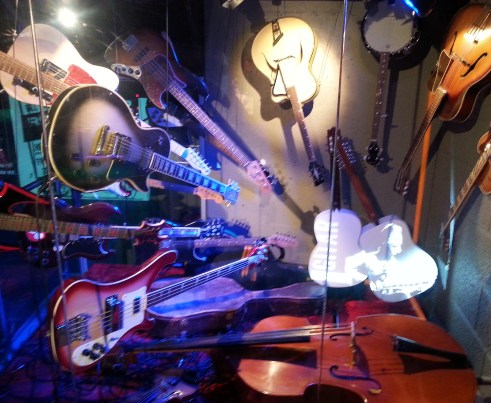
After that we dashed to the Popsenteret for some afternoon fun, Oslo’s museum about the history of Norwegian pop music. Slightly hidden in a courtyard situated parallel to the street listed online, the Popsenteret is an interactive museum. Inevitably and quickly we walk past an exhibit about the band A-ha and I start singing along. “Taaalking away/ I don’t know what I’m to saaay/ I’ll say it anyway/ Today’s another day to find you/ Shyyying away/ I’ll be coming for your love, OK?/ Taaake ooon me (take on me)/ Taaake me ooon (take on me)/ I’ll be gooone/ In a day or twooo…” Ach, the memories! Such nostalgia. There’s also a booth for recording yourself and a drum set with some headphones where we let loose. The results did not sound bad at all!
IMG_20160319_100256

A very special city, indeed. A kaleidoscope of impressions, experiences and memories. Oslo!

Standard
My Travel

Oslo, Day 4. Oslofjord and Skybar

We made it back to town with time enough to run by the nearest 7-Eleven and grab a snack, which felt routine by now. Then we caught the last ferry from the B1 dock right opposite the City Hall. My friend had recommended doing this, as the ferry is included in the Oslo Pass transportation and it goes around several islands in the Oslofjord, providing stunning views everywhere you look. We sat outside, of course, with the fresh fjord winds blowing in our faces.

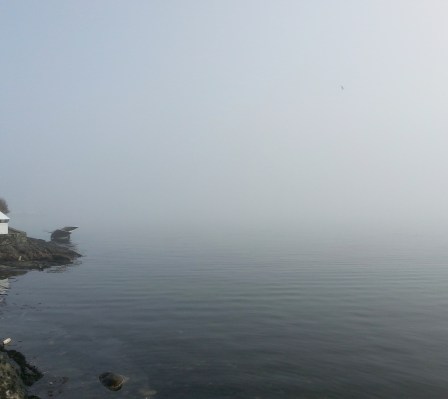
My guidebook mentioned this trip, saying taking it was like a refreshing morning shower. If you are slightly sleepy from the day’s activities (which we weren’t, I mean, vikings), this is the thing to do to wake up again before proceeding to the evening. Not a trace of the morning fog was to be seen. From this:

IMG_20160317_180650

To this:

Photo credit @juniperlu

Photo credit @juniperlu

We could not have asked for better conditions to be out on the water. Going out on a boat on a fjord is on the list of things to do when one is in Norway (so is swimming in one, just need to wait a few months). The round trip takes an hour and you find yourself completely submerged (pun!) in the stunning, raw beauty of the landscape around you. The air is so clear, you almost forget that you are travelling around a city, ducks and seagulls occasionally bob along the boat on the water, and the islands of the Oslofjord are dotted with the already mentioned colourful quintessentially Norwegian houses.

Cities built near the water certainly have an advantage, and with my love for Hamburg and its rivers already going strong, it was easy to open up my heart to Oslo too. Especially because Oslo, like Hamburg, is also a city with character and individuality. But the connection to water has always been a special thing for me. On and on we sailed, watching small waves splash upon the fjord. It was very peaceful and after the first stop there was just one other person on the top deck besides us.

By the end of the trip my fingers were stiff with cold despite gloves and I made dancing motions with my legs until we docked again by the City Hall. A very good tip for making a trip around the Oslofjord without paying additionally for a tour and with the added freedom of simply observing quietly as the ferry makes its way around the islands.

The low budget section of my guidebook listed one particularly intriguing item, which we left for the evening. A short walk brought us to the Radisson Blu Plaza Hotel not far from the Central Station. As we approached it, we saw what we were looking for: a circular glass lift made its way up one side of the building, all the way to what I knew to be the 34th floor. After asking at reception where to go, we ended up using the normal lift (so ask how to find the glass one). It took us to the 33rd floor, but one short flight of stairs and a helpful sign later, et voilà, welcome to the Skybar.

We made our way across the cosy, dimly lit room, claimed some armchairs right by the enormous windows spanning the area, and just stopped to look. Because the nighttime view of Oslo from up there was indescribable. We just stared for a while, and all I could do was sigh. Besides armchairs, the windowsills are wide enough to sit on. The atmosphere was once again incredibly relaxed, as were the guests around us, and any small worries I had about dresscodes and such evaporated.

The drinks menu held some intriguing titles, and at first I went for a cocktail containing “traces of alcohol” called Smell of Flowers, which was fun to ask for, even if in the end my receipt said VIRGIN BREEZE. The drink was tasty and indeed flowery, and as I leaned back in my seat, cocktail glass in hand, drinking in (another pun) the view of Oslo and its diamond lights spread out below, I thought, wow, what an absolutely fantastic moment.

gatsby

After asking at the bar, we found the glass lift, and I was glad I had a drink before going on it, because I did have to close my eyes for the first few seconds during descent. After that we went up, as we had originally intended, and then back down again, and it was indeed worth it. A fitting end to our last evening in Oslo.


Standard
My Travel

Oslo, Day 4. Bygdøy

This was the only foggy morning we experienced in Oslo. Two groups of children got on the same bus as we did, clearly also on their way to the museum island of Bygdøy (a friend told me how to pronounce this correctly, but unfortunately I keep switching to the German way of doing it in my head, which is funny, considering the name contains a letter the German alphabet does not have).

One group consisted of small schoolchildren from Germany, and the other of still smaller Norwegian ones in neon orange vests. The latter simply sat down on the floor of the bus and I amused myself for a while imagining reactions of fellow passengers if this happened in Deutschland. Possibly “Die Kinder dürfen nicht auf dem Boden sitzen.” One little girl boarded the bus in colourful sunglasses and didn’t take them off for most of the trip. Norwegian cool! Apparently it starts from an early age.

The bus number 30 stops in front of every attraction on Bygdøy – another very satisfying transport experience in Oslo for me. My guidebook also told me I could not get lost, as there were signs everywhere, which is true, also no one acts like they can get lost, and as we all know, the right mindset is everything.

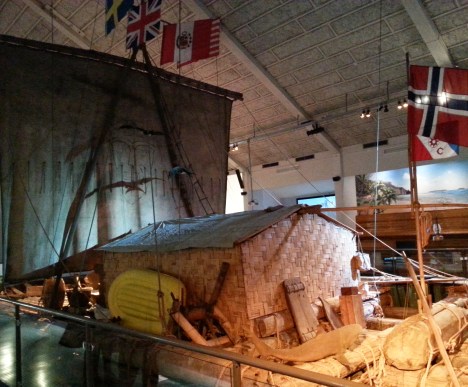
Our first stop was the Kon-Tiki Museum, which I expected to be small and done in a quick tour. Was I ever wrong. A fascinating story opened up to me and I was wondering whether I had really missed this, or simply forgotten. The extraordinary account of Thor Heyerdahl’s trip across the Pacific Ocean on the Kon-Tiki raft in 1947 is constructed in a comprehensive exhibit built around the raft itself. Video and audio plays in the background, additionally animating the story.

The museum also shows artefacts from other daredevil expeditions that Heyerdahl undertook, as well as models of his other (!) rafts. What struck me especially is how much writing he did, not just for scientific purposes, both on his expeditions and between them. After seeing the suggestively realistic underwater exhibit cleverly connected to the raft above, and walking half-bent through a reconstruction of a cave (warning, yes, it is on the narrower side), I immediately bought the book about the Kon-Tiki expedition in the museum shop (generally good stops in the Oslo shopping plan. Psychedelic colouring pencils in the Munch Museum, anyone?).

I couldn’t stop thinking about the fact that several men had actually slept, worked and sailed on this thing in the middle of the PACIFIC OCEAN. On a RAFT. As well as that so many people told Heyerdahl he would never, ever be able to do it…and he did.
IMG_20160317_114331

Inspired and curious after this first fascinating tale, we proceeded to the next museum bearing evidence to more mind-blowingly daring things done by Norwegian explorers – the Fram. By the roof you can tell the building houses a ship. Inside we end up walking downstairs first and watching a bit of the running documentary about the polar expedition made by Roald Amundsen (memories of geography lessons in school start to stir) between 1903 and 1906, aboard the Gjøa. This vessel was the first to sail along the Northwest Passage.

After a few minutes of the film and walking around, observing the numerous instruments, kits, journals, pictures, bottles and clothing, it sinks in just how daunting, not to mention risky, such an undertaking was in those times, when neither science nor technology was as advanced as it is today. These polar expeditions were unimaginably rough, and one can understand the bottles of aquavit displayed around the ship. You would drink too if it happened to you, doo-doo-doo-doo-doo.

IMG_20160317_131030

Fueled by horrified fascination and admiration, we proceeded back to the Fram. First Fritjof Nansen and his crew sailed to the North Pole from 1893 to 1896, achieving fame in Norway and beyond as a result, both for themselves and the Fram. In 1912 Roald Amundsen once again surfaced in connection with a polar expedition, sailing to the Antarctic, to subsequently be the first to reach the South Pole on dog sleds.

The Fram is very big and very impressive, and it’s also possible to go aboard.  Signs with “Please don’t climb on the rigging” are tacked on in several strategic spots. I look down from above. Really? I mean, seriously? Who would even come up with the idea?

Walking on deck I try to imagine the unknown vastness of the North Pole opening up ahead of me, with nothing but ice ahead, and maybe nature making some noise. Inside narrow sets of steps repeat themselves every now and then, as we go from room to room, all of which are quite cosy, though the ceilings are low and I think having only these places to go to for months on end must have been exhausting, though the explorers knew what they might be up against, as best as they could.
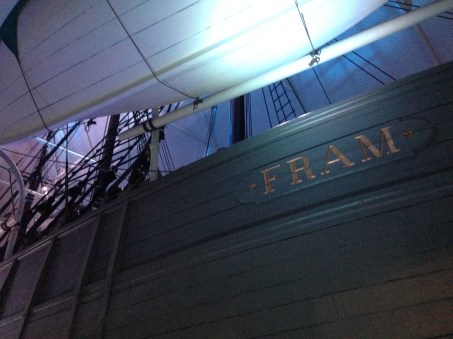
Photo credit @juniperlu

Photo credit @juniperlu

To complete the polar experience, make sure you pop in to this here Arctic simulator. I walked past this door three times before I realized that was the entrance. No more excuses now! And not because of the sub-zero temperatures, been there, done that, hair flip.

IMG_20160317_180423

Next stop – the Viking Ship Museum! For what would a visit to Norway be without connecting with its viking history? The Vikingskiphuset houses artefacts and actual ships found in graves around the Oslofjord. The ships were used by vikings for sea voyages first, and then eventually hauled ashore to become burial vessels. Considering the amount of things (and animals) buried with the dead, one understands the use of the ships, and also with the significance attached to them in the viking way of life, there is something poignant about them being further connected to death and the afterlife, something, perhaps, about viewing sailing as eternal, both literally and spiritually. But these are my own musings only.

The first ship you see, with beautiful carvings on the front, was found at Oseberg, and it was a grave for two powerful women, one of whom had lived past the age of 80 (impressive for times when lifespans were famously short). The other ships and artefacts come from Gokstad, Tune and Borre. All had been ransacked and robbed before being discovered, unfortunately, but they are still currently the best preserved viking ships in the world. Somewhat skeletal, but eerily beautiful, it feels like images of the ships’ former glory are just out of reach. With my imagination buzzing, I made a stop at the museum shop here as well and got a book on viking times. I might have also browsed a little longer by the stall with the viking jewelry replicas. The costume jewelry ones, not the real silver, more expensive ones.

Photo credit @juniperlu

Photo credit @juniperlu

From ships and sailing we proceeded to our last stop – the Norwegian Folk Museum. Upon entering we receive a map with a useful “do not miss” section, which we duly peruse. The Norsk Folkemuseum exhibition is located completely outdoors (with free WiFi available) and it is very easy to feel as if you have indeed gone back in time, alternating between periods. Showing life in Norway from as far back as 1500, the museum does this through 160 historic buildings relocated from various sites. We barely saw anyone while there, which contributed to the pleasantly tingly ghosttown feeling (but since by this point it was sunny again, my imagination quieted somewhat after the viking ships).

A particularly interesting stop is the Wessels Gate 15 apartment building, which you can enter and see 8 apartments with interiors from the past 130 years. This was very cool, especially since it looked like the owners would pop back in any minute. The sun was still shining and a Beatles song was playing in the 60s section. One kitchen we could go in, but I couldn’t open any cupboards or drawers (probably nailed shut precisely because of visitors like me). The rest was observed from behind glass walls.

This slideshow requires JavaScript.

So much history in one day, and absolutely worth the time. I can’t even begin to decide which attraction I enjoyed most – they were all part of an incredibly exciting discovery of Oslo’s museum landscape. All of the above are included in the Oslo Pass.

We caught the bus and settled back to digest the day’s impressions during the next 20 minutes until getting out in town. Then we realized we still had time for another planned activity…

Standard